

 Polski
With Scout, you monitor all machines, including those without a CNC or PLC controller.
If you have conventional or manual machines in your company, i.e. those that are not numerically controlled by a CNC or PLC controller and you want to monitor their operation, we have a way to do it. This also applies to older CNC machines, press brakes or lasers.
In order to monitor the operation of these machines we supply an I/O (Input/Output) module:
BIOS-IO-01
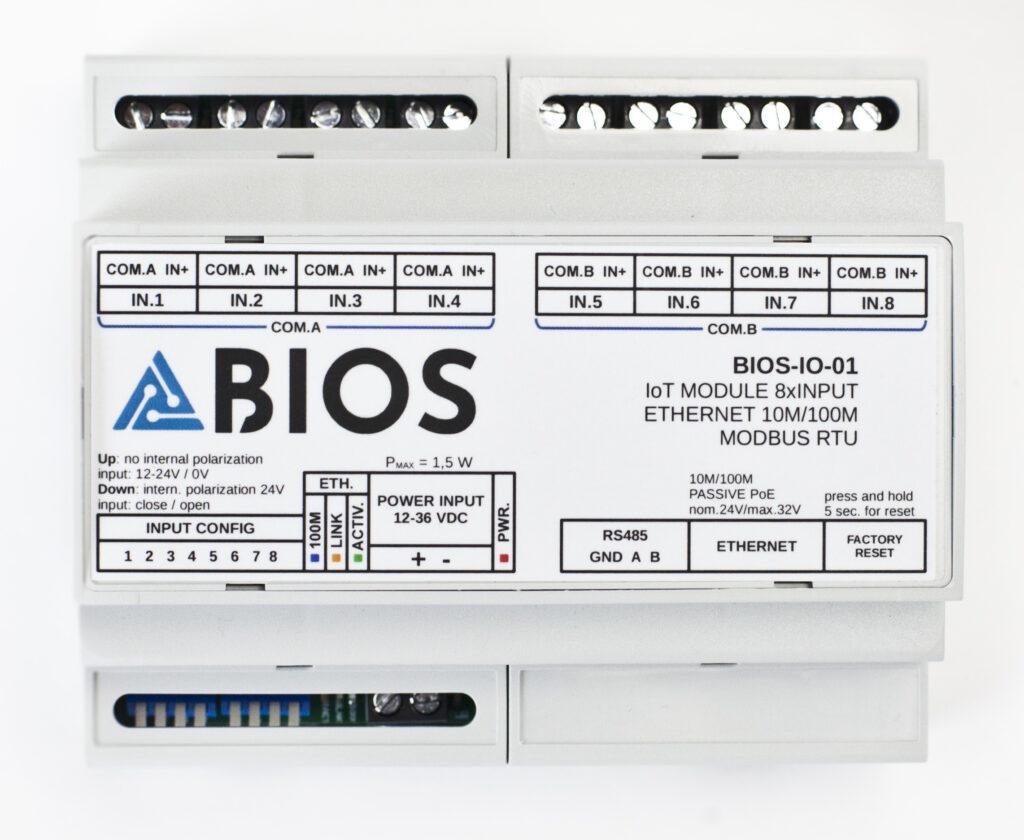
With the BIOS-IO-01 digital inputs module, it is possible to read the states of digital signals from the machine and then transmit them via LAN to our SCT software. The SCT then passes the data on to the Scout server:
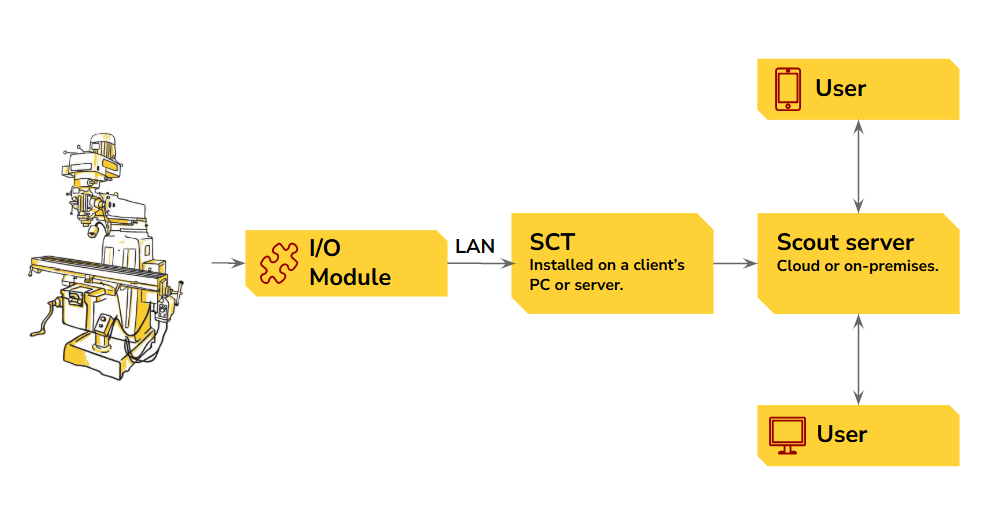
The BIOS-IO-01 module is often used to connect signals from an “indication light” mounted on the machine. The inputs on the module also work in pulse count mode. Configuration of the module is simply a matter of setting the LAN IP address on the module.
Examples of information that can be read by the BIOS-IO-01 module:
- state of the machine: running, not running, presence of an alarm
- state of the periphery, e.g. machine door open
- the moment the pedal is pressed on a press brake (= running)
- counting of parts, e.g. in a paint shop or other machine where parts move on a belt, rollers, or in some other way
- roller revolution counting in printing machines ( = meters of material, speed)
- …any other information identified by 10-24 V DC signals.
BIOS-IO-01 Technical Specifications
- number of inputs: 8
- input type: NO voltage or with internal polarisation (closed/open), optoisolated,
- input voltage: 10-24VDC or circuit closed/open,
- maximum counter value: 4 294 967 296,
- maximum input frequency: around 3 000 Hz.
- 1 Ethernet port 1x100Mbps.
- HTTP JSON protocol to read and set data
- 12-24VDC via 3.5mm screw connector,
- 12-24VDC Passive PoE via LAN connector,
- power consumption max 2.5W.
With the BIOS-IO-01 module, you can monitor the operation of any machine. In case when LAN network is not available, we use different I/O modules with GSM communication.